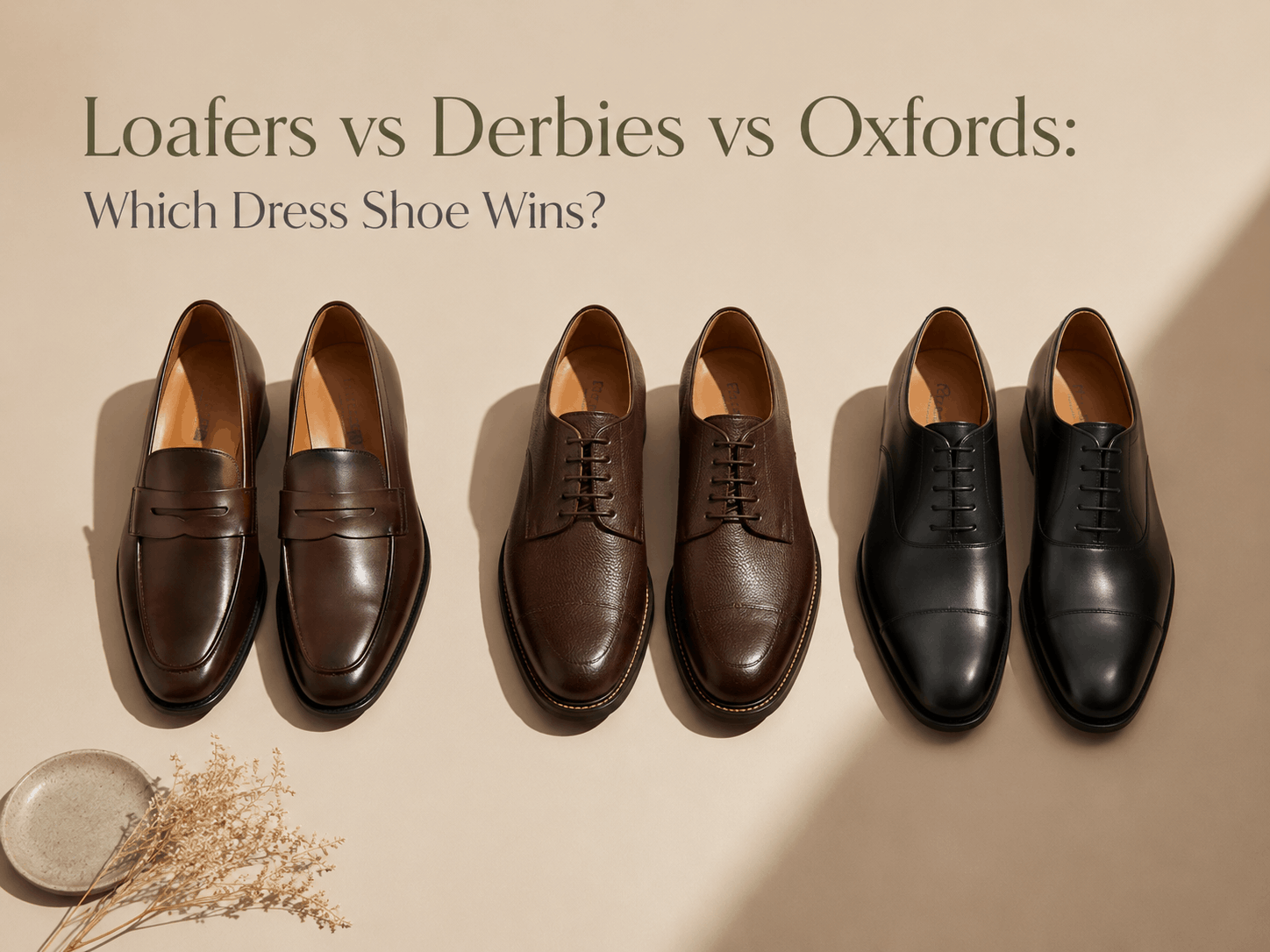
The short answer on loafers vs derbies vs Oxfords: Oxfords are the most formal (closed lacing, sleek silhouette), derbies are the versatile middle ground (open lacing, roomier fit), and loafers are the most relaxed (no laces, slip-on ease). If you own only one dress shoe, make it a dark brown derby; it dresses up and down further than the other two.

In This Guide
- Loafers vs Derbies: The Key Difference
- Where the Oxford Fits In
- Side-by-Side Comparison
- The Styles Worth Knowing
- Which Shoe for Which Occasion
- Fit, Sizing & Materials
- FAQ
Loafers vs Derbies: The Key Difference

A loafer has no lacing system at all; it’s a slip-on, defined by its low profile and exposed ankle. A derby is a lace-up whose eyelet facings are stitched on top of the vamp (open lacing), which lets the shoe flex open. That single construction detail changes everything: the derby accommodates higher insteps and wider feet, while the loafer trades security for sprezzatura, that studied Italian ease.
Practically: derbies anchor tailoring and structured smart casual; loafers own summer, sockless styling, and any outfit that needs to look effortless. Neither is “better”; they solve different problems.
Where the Oxford Fits In

The Oxford uses closed lacing: the eyelet facings are stitched under the vamp, creating one continuous, sleek line across the top of the foot. That’s why the Oxford is the most formal shoe a man can wear; it’s the default under a dark suit, the only correct choice with black tie (in patent leather), and the sharpest option for interviews and formal weddings.
The trade-off is inflexibility, both literal and stylistic. Closed lacing fits snugly and suits lower insteps, and a black cap-toe Oxford looks out of place with jeans or chinos. It’s a specialist; the derby is the generalist.
Side-by-Side Comparison
| Feature | Loafer | Derby | Oxford |
|---|---|---|---|
| Lacing | None (slip-on) | Open — facings on top of vamp | Closed — facings under vamp |
| Formality | Casual to smart casual | Smart casual to business | Business to black tie |
| Best with | Chinos, pleated trousers, shorts, sockless looks | Suits, flannels, dark denim | Suits and formalwear only |
| Fit suits | Average to narrow feet | High insteps, wider feet | Low to average insteps |
| Seasonality | Spring/summer champion | Year-round | Year-round |
| If you own one | Dark brown penny | Dark brown plain-toe ⭐ | Black cap-toe |
The Styles Worth Knowing
- Penny loafer. The strap across the vamp with its diamond cut-out is the most versatile loafer detail: collegiate in suede, boardroom-adjacent in polished calf. This is the loafer to buy first.
- Horsebit loafer. The metal snaffle bar, an equestrian detail made famous by the Italian houses, adds instant polish and a hint of flash. It pairs brilliantly with pleated trousers and a knit polo; Gucci built half a century of style equity on this exact shoe.
- Tassel loafer. Slightly dressier than the penny, with an American lawyer heritage. Best in dark suede or burgundy calf.
- Plain-toe derby. The single most useful dress shoe in menswear. Dark brown calf, round toe, Goodyear-style welt; it handles a suit on Monday and dark denim on Saturday.
- Suede derby. The texture play: softer, warmer, and more forgiving with casual fabrics. A tobacco suede derby with charcoal flannels is one of the great autumn combinations.
- Cap-toe Oxford. A single seam across the toe. In black calf, it’s the interview, wedding, and funeral shoe the most formal lace-up short of patent leather.
- Wholecut Oxford. Cut from a single piece of leather with no seams at all. Minimalist, modern, and unforgiving of cheap leather, the silhouette lives or dies on the material.
Which Shoe for Which Occasion

Office and business meetings: derby or Oxford, brown or black calf. Weddings: Oxford for formal invitations, derby or horsebit loafer for daytime and summer ceremonies. Dates and dinners: loafers; they signal ease, and ease is attractive. Smart casual anything: all three work; calibrate with the rest of the outfit using our smart casual outfit guide.
Dress shoes are one of the five footwear archetypes every wardrobe needs; the full picture is in our rundown of the 10 shoes every stylish man should own. And if your rotation is sneaker-heavy, one pair of loafers plus one pair of derbies fills the entire formal gap in a luxury capsule wardrobe.
Fit, Sizing & Materials

Loafers must fit snugly from the first wear; there are no laces to compensate, and leather only loosens with time. Expect gentle grip at the heel and no slipping by the third wear. Derbies are the forgiving ones: open lacing absorbs half a size of variance and suits high insteps. Oxfords run sleek and low if you’re between sizes; size up rather than crush the instep.
On materials: full-grain calf ages best and takes a shine; suede is more casual and surprisingly durable with a protector spray; patent is for black tie only. A Goodyear welt construction means the sole can be replaced, extending a shoe’s life by years. Craftsmanship details like these are exactly what separates the great makers. Our look inside the world of Berluti shows how far patina and construction can go. You’ll find the full range of luxury-inspired dress silhouettes in the Hollo formal shoes collection.
Dress Shoe FAQ
Are loafers more casual than derbies?
Yes. The absence of laces makes loafers inherently more relaxed. A dark leather loafer can still handle a summer suit, but a derby always reads one notch more formal in the same leather.
Can I wear derbies with a suit?
Yes, derbies with a suit are standard modern business dress, especially in brown calf with navy or grey. Only the most formal occasions (black tie, formal evening weddings) demand an Oxford instead.
What’s the difference between a derby and a blucher?
They’re near-identical cousins. On a derby, the quarters (the eyelet panels) are separate pieces stitched onto the vamp; on a blucher, only small eyelet tabs are sewn on. In everyday use, the terms are interchangeable; both mean open lacing.
Should my first dress shoe be black or brown?
Dark brown. It pairs with navy, grey, green, and denim, and it develops character with age. Black is essential only if your work or events demand strict formality.
Can I wear loafers without socks?
Yes, that’s half their charm in summer. Use invisible no-show socks to protect the lining, and rotate pairs so each gets a day to air out.
Are Oxfords uncomfortable for wide feet?
They can be closed-lacing and have little give across the instep. Wide-footed men are almost always happier in derbies, which open up and adjust. It’s a construction issue, not a quality issue.
How many dress shoes does a man need?
Three covers everything: a dark brown derby for daily tailoring, a loafer for warm weather and ease, and a black cap-toe Oxford for formal occasions. Rotate them and all three last for many years.
Do designer dress shoes run true to size
It varies by house; Italian lasts often run narrow and slightly long. Check each product’s sizing notes, and when between sizes: size up in Oxfords, stay true in derbies, size down half in loafers if the brand recommends it.
The Verdict
Buy the derby first, add the loafer for ease, and keep an Oxford for the days that matter. Three silhouettes, every occasion covered. Explore luxury-inspired takes on all three in the formal shoes edit at Hollo.
Get the next guide first. Join The Journal newsletter for weekly menswear briefings, styling formulas, and early access to new arrivals.