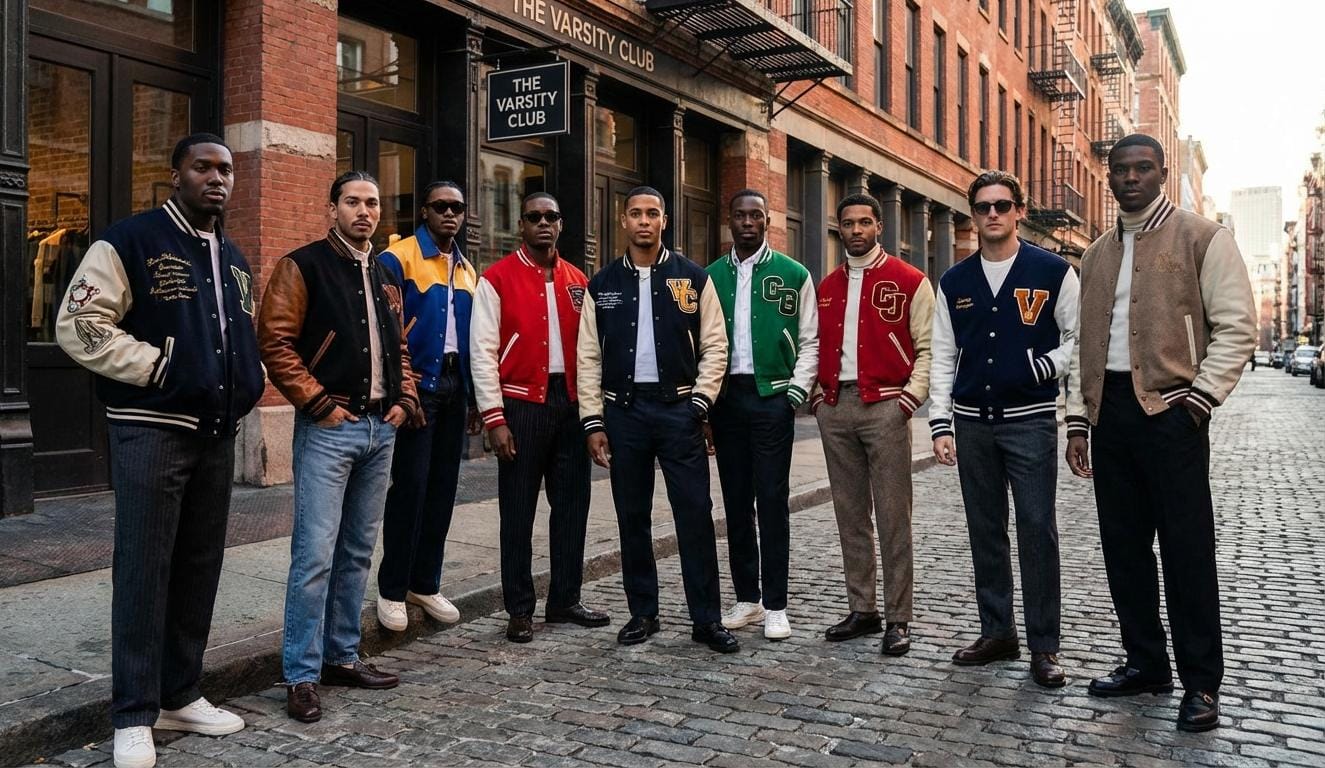
Most men do not need ten jackets. They need three. A bomber or varsity for casual wear, a puffer for genuine cold, and a wool overcoat for anything that requires looking serious. A leather jacket sits between the first two. Choose by the temperature range you actually live in, the trousers and shoes already in your wardrobe, and how much shoulder structure suits your frame.
Which designer jacket should you buy first?

If your wardrobe currently has no outerwear beyond a hoodie, buy in this order: bomber or varsity first, overcoat second, puffer third. The first two cover roughly 80% of the days you will actually get dressed for. The table below is the short version of everything that follows.
| Jacket | Best temperature | Formality | Wears best with |
|---|---|---|---|
| Varsity | 10-18°C / 50-65°F | Casual | Denim, cargos, sneakers |
| Bomber | 8-18°C / 46-65°F | Casual to smart casual | Chinos, denim, leather sneakers |
| Leather | 7-16°C / 45-60°F | Casual to smart casual | Dark denim, boots, knitwear |
| Puffer | Below 5°C / 41°F | Casual | Heavy knits, tapered trousers, boots |
| Wool overcoat | 0-12°C / 32-54°F | Smart to formal | Tailoring, roll necks, dress shoes |
What makes the varsity jacket work in 2026?

The varsity jacket- wool body, leather sleeves, ribbed collar and cuffs began as American college-award outerwear and has spent the last decade being reinterpreted at the luxury end of menswear. What keeps it relevant is proportion: the ribbed hem stops at the waist, visually shortening the torso and lengthening the leg. That flatters almost every build.
The mistake men make is treating it as a statement piece and then styling everything else loudly too. A varsity is already doing the talking. Put it over a plain crew-neck tee or a fine-gauge knit, add straight or slightly tapered denim, and finish with clean, low-profile sneakers. Nothing else needs to happen.


Look for chenille or embroidered patchwork rather than printed graphics, a wool-blend body with real weight, and snap buttons that sit flush. Browse the varsity jackets collection for luxury-inspired versions across colorways.
Bomber vs varsity: what is the actual difference?
They share a silhouette, cropped, ribbed hem, and ribbed cuffs, but the bomber is the quieter, more adaptable of the two. It has no contrast sleeves, usually no patchwork, and is typically made in nylon, technical fabric, suede, or leather rather than wool.

That neutrality is the point. A black or navy bomber goes over a shirt without looking like sportswear, which a varsity cannot quite manage. If you work somewhere with a relaxed dress code, the bomber is the more useful purchase. Our guide to smart casual outfits for men covers exactly where that line sits.
Is a designer puffer worth it, or is any puffer the same?
Puffers differ in three measurable ways: fill power, baffle construction, and shell fabric. Fill power measures down loft; higher numbers trap more air per gram, so a 700-fill jacket is warmer and lighter than a 550-fill jacket of the same weight. Baffle construction matters because stitch-through baffles create cold spots at every seam, while box-wall baffles do not.


Design houses add value in the silhouette. Most technical puffers are cut wide and boxy, which reads as ski-lodge rather than city. Fashion-house puffers are cut closer through the body with a shorter hem, so they layer under nothing and over tailoring without adding bulk at the hip.
Buy black, navy, or a deep neutral for your first one. Save the color for your second. Our Moncler-inspired and North Face-inspired pieces sit at opposite ends of that spectrum: one refined, one outdoors-led.
When does a leather jacket beat everything else?

In the shoulder seasons, roughly 7- 16 °C, when it is too cold for a shirt alone and too mild for anything insulated. Leather blocks wind in a way wool does not, which makes it warmer than its weight suggests.
Two silhouettes are worth owning. The café racer is minimal, band-collared, and works with tailoring. The biker has an asymmetric zip and lapels, and it is a purely casual piece. If you only buy one, buy the café racer, because it does both jobs adequately while the biker does one job well.
Why does the overcoat still matter?

Because it is the only jacket on this list you can wear to a wedding, a funeral, a client meeting, and a dinner without changing anything else. A single-breasted wool overcoat that ends just above or just below the knee is the highest-leverage outerwear purchase a man makes.
Get the length right. Above mid-thigh looks abbreviated. Below the knee needs height to carry. Charcoal and navy are more useful than camel, though camel is more interesting. Check the wool content: a high-wool blend drapes and recovers; a polyester-heavy blend creases and stays creased. The Woolmark Company publishes useful background on how wool fiber behaves in outerwear.
How should a designer jacket actually fit?

Four checkpoints, in order of importance:
- Shoulder seam: should land at the edge of your shoulder bone, not past it. This is the one thing a tailor cannot fix cheaply.
- Sleeve length: ends at the wrist bone. On bombers and varsities, the ribbed cuff should sit there without being pushed up.
- Chest room: you should be able to zip it over a mid-weight knit and still cross your arms.
- Hem: cropped jackets end at the waistband. Overcoats end at or just below the knee. Nothing should end mid-hip; that is the least flattering length there is.
Many European luxury houses cut narrower through the chest and shoulder than American or British labels. If you are between sizes and buying an outer layer, size up; you are layering under it.

What shoes go with each jacket?
| Jacket | First choice | Avoid |
|---|---|---|
| Varsity | Chunky or retro sneakers | Dress shoes |
| Bomber | White minimalist leather sneakers | Heavy work boots |
| Leather | Chelsea boots, Derby boots | Running shoes |
| Puffer | Chunky sneakers, hiking-inspired boots | Loafers |
| Overcoat | Oxfords, Derbies, sleek leather sneakers | Chunky sneakers |
If you are unsure which of those you already own, our guide to the 10 shoes every stylish man should own covers the full footwear rotation, and how to style luxury sneakers covers sneaker-with-outerwear pairings in more depth.
Five mistakes that ruin good outerwear
- Buying the loudest one first. Your first jacket in any category should be the one you can wear weekly, not the one that photographs best.
- Ignoring the hem length. Mid-hip is the dead zone. Go cropped or go long.
- Layering bulk under bulk. A thick hoodie under a puffer distorts the shoulder line. Use a fine merino or cashmere layer instead.
- Matching leather to leather exactly. A leather jacket and leather boots in slightly different tones look intentional. Identical tones look like a set.
- Skipping the accessories. A jacket without a watch, belt, or scarf reads unfinished; see our men’s luxury accessories guide.
Building the rotation

Three jackets, bought in the right order, cover a full year in most climates. Add a fourth only when you can name the specific gap it fills. Our guide to fall wardrobe essentials for men puts outerwear in context with the knitwear and trousers that sit underneath it, and the full winter collection covers the cold-weather end of the range.
Frequently asked questions
How many jackets does a man really need?
Three covers most climates: one cropped casual jacket (bomber or varsity), one insulated jacket (puffer), and one wool overcoat. A leather jacket is the natural fourth.
Can you wear a puffer jacket over a suit?
Only if the puffer is slim-cut, ends at or just below the waistband, and comes in a solid dark color. A boxy or knee-length puffer will crush the suit’s shoulder line. A wool overcoat is the safer choice.
Should you size up in a designer jacket?
Usually yes, if you are between sizes. Many luxury houses cut narrower through the chest and shoulder than mainstream brands, and outerwear needs room for a layer underneath. Check the shoulder seam first; it should land at the edge of your shoulder bone.
What color jacket is the most versatile?
Black for leather and puffers, navy or charcoal for overcoats. These pair with denim, tailoring, and knitwear without competing. Save color and patchwork for a second jacket once you’ve covered the neutrals.
Are varsity jackets still in style?
Yes. The varsity has moved from a trend cycle into a permanent luxury menswear staple, largely because its cropped, ribbed-hem proportion flatters most builds. Chenille patchwork and wool-blend bodies read more current than printed graphics.
Explore the full Hollo clothing collection for luxury-inspired outerwear across every silhouette covered above.
2 responses to “Men’s Designer Jackets: Varsity, Puffer, Bomber, Leather or Overcoat?”
[…] outerwear. A varsity, a bomber, or a monogram puffer the piece that does the talking. Our guide to men’s designer jackets covers how to choose between […]
[…] Because of that volume, the puffer is visually dominant. Everything else has to work with the proportion rather than compete against it. Whether you are buying your first luxury piece or trying to get more mileage out of the one you already own, this guide gives you specific outfit formulas for streetwear, weekends, travel, smart casual, dinner and hard winter weather. To see how the puffer sits within the rest of your outerwear rotation, see our guide to men’s designer jackets. […]